

The Basics
Who is Protect Grove City?
Residents. All kinds of them. This is not a political organization, a business coalition, or one neighborhood with an agenda. It’s farmers, business owners, retirees, people whose families have been here for generations, and people who moved in last year, who all landed in the same place about industrial development next to homes and farms.
Is this a ban on data centers?
It isn’t a ban. But it does give you a say. A hyperscale data center is exactly the kind of project that crosses these lines … 310 acres off Rensch Road is what started this. If another one comes calling, Issue 28 is what puts that decision in front of you instead of around you.
It also isn’t only about data centers. Issue 28 names no industry. It says a project big enough to permanently change the city has to make its case to the people who live here and win their vote first. A developer with a good project can still build it. They just have to ask.
We wrote it that way on purpose. Naming one industry would have been the weakest version of this … easy to attack as targeting a single company, and out of date the moment the next thing comes along. Scale doesn’t go out of date.
What is the Protect Grove City campaign?
We’ve already gathered enough signatures to place the Community Consent Amendment on the ballot as a Grove City Charter amendment. It appears as Issue 28 on November 3, 2026. The petition phase is done … now it comes down to turnout. We need you, your friends, and your family to vote yes and to make sure the people you know know it’s on the ballot at all.
What is the Community Consent Amendment?
The Community Consent Amendment is a proposed addition to Grove City’s City Charter. It creates a mandatory referendum process: before any qualifying large-scale industrial development can receive any city approval, registered Grove City voters must first approve it at the ballot box. No vote, no approval. Full stop.
Why is this needed right now?
Grove City’s development director, Kyle Rausch, said in his presentation at the moratorium meeting that conversations with the developer began in early 2025. Residents didn’t learn about the 310-acre data center campus until 2026. More than a year passed between the first conversation and the public finding out about it.
Residents pushed back hard, and that project was turned away. But nothing in current law required anyone to say a word while it was happening, and nothing stops the next one from following the same path. Issue 28 puts a public vote at the point the decision actually gets made, which is the one approval that can’t happen quietly.
What Triggers the Referendum Requirement
What kinds of projects would require a public vote?
Very little of what gets built in Grove City in a normal year. These numbers are aimed at the largest projects the city ever sees.
If Issue 28 passes, a proposed project goes to a public vote if it hits any one of these:
- 50 or more acres in total project footprint … roughly 38 football fields under a single development
- More than 20 megawatts of electrical demand at peak … about what it takes to power 16,000 homes
- More than 500,000 gallons of water a day … around 750 backyard swimming pools, every day
One is enough. A project doesn’t have to hit all three.
Put the other way: the kind of development Grove City actually sees in a normal year … a restaurant, a medical office, a neighborhood shopping center, a small manufacturer … doesn’t come near these numbers. And nothing already operating in Grove City faces a public vote on what it does today. See the next two questions for how the numbers were set and how existing operations are handled.
How it gets decided. When the city receives a rezoning application, annexation petition, conditional use application, planned development application, or even a pre-application inquiry for something that could plausibly reach one of the thresholds, the City Law Director has 15 business days to issue a written determination on whether it’s covered. Applications that plainly can’t reach a threshold don’t trigger the process at all. The applicant or the public can appeal a determination to City Council within 30 days.
We read that written-determination-and-appeal structure as evidence that these aren’t simple measurements. Acreage has to be added up across phases, across related companies, and across parcels separated only by a road. Power and water are projections at the application stage, not meter readings. You don’t build an appeal process on top of arithmetic.
Others read it more strictly, and we’re not going to argue the point here. Assume the strict reading is right and there’s no judgment involved at all. The practical answer doesn’t change: the numbers sit far above anything this city builds in an ordinary year.
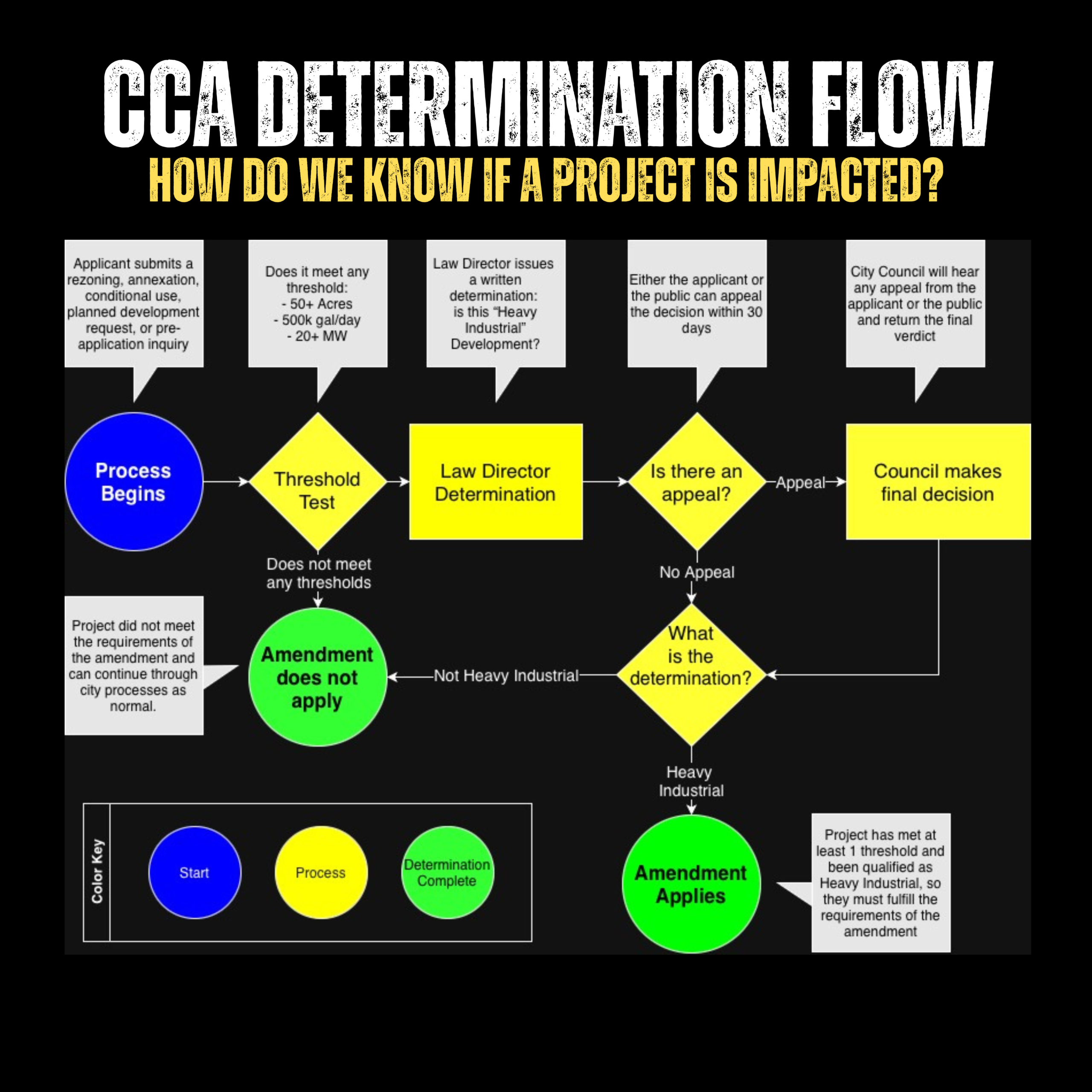
How we read the determination process, from application to final decision.
Why those specific numbers?
The thresholds are calibrated to capture projects large enough to permanently reshape the city, while leaving everyday commercial development untouched. For comparison, American Nitrile (~30.14 acres) and the Meijer development (~28.12 acres) both sit comfortably under every threshold and wouldn’t trigger the requirement. A 310-acre data center campus would trigger it outright, several times over. Fifty contiguous acres is roughly 38 football fields under one project. Very little that gets built here comes close.
Could a developer split up a project to get under the thresholds?
No. The amendment includes an anti-circumvention rule. If a company tries to split one large project into smaller pieces, even under different company names or filed at different times, the total footprint is still counted together. The law looks at substance, not paperwork structure.
Are existing businesses affected?
Some are. Our earlier answer here was a flat “no,” and that was too simple. Thanks to Jeffrey Tadlock for flagging it … he read Section [X].19 more closely than our own FAQ did, and he was right to call it out.
We also thought this went further than it needed to. The compromise we put in front of Council on September 3 would have exempted existing Grove City businesses from the amendment outright. It got four votes and needed five, so it isn’t what’s on your ballot. Here’s what is.
If a facility is already operating below all three thresholds, the amendment doesn’t reach it. That’s nearly everything in Grove City.
If a facility is already at or above a threshold, Section [X].19 gives it one specific and significant protection: it never has to win a retroactive referendum for what it is doing today. Nobody who built lawfully should have to go back and ask permission after the fact.
That protection is not a blanket exemption, and here is exactly what it doesn’t cover. A facility at that scale files a Baseline Declaration with the City Clerk within 180 days. It files quarterly operations reports whether or not it registers. It funds a one-time ambient baseline measurement. It stays subject to the Community Impact Standards and to the enforcement provisions. And under Section [X].10 it stays subject to material change review, which means a cumulative increase of more than 10% in acreage, power draw or water use, a change in primary use, a relocation of more than 500 feet, or a transfer of ownership to a different beneficial owner would each require a public vote.
Why does an existing facility have to report at all?
Because grandfathering only means something if someone can tell whether it still applies. The protection covers the operation as it exists today, so today’s operation has to be written down and measured against. Without a baseline on file and a regular report against it, “you’re protected at your current level” is an honor system, and the first time a facility quietly doubled its power draw, nobody would find out until the neighbors did.
The reporting isn’t a penalty stacked on top of the protection. It’s what makes the protection real, and it’s what makes the 10% line enforceable rather than theoretical.
The one-time ambient measurement works the same way. The impact standards are measured against a baseline reading, and a facility that was already running never had one taken. Somebody has to take it now, or those standards can’t be applied to that facility at all.
And the fix is still on the table.
That compromise version still exists. If Council wants existing businesses treated differently, it can put that question to voters at the next election … there’s one in May 2027. Nothing about passing Issue 28 stops that. What a no vote stops is you having a say in the developments big enough to change Grove City. What happened to the compromise →
How the Public Vote Works
Who pays for the election?
Not taxpayers. Before an application can even be considered complete, the applicant has to deposit the full cost of the referendum with the City Auditor. It’s held in escrow, it can only be spent on referendum costs, and anything left over goes back to the developer.
What happens if voters say yes?
The project can proceed to standard city approval processes: zoning, building permits, and so on. A yes vote clears the referendum hurdle but doesn’t bypass other normal requirements.
What happens if voters say no?
No city approval of any kind can be granted. The developer cannot reapply with the same or a substantially similar project for 24 months. A no vote has teeth.
What about residents in neighboring townships?
Only Grove City residents vote in the referendum. A city charter can’t hand the vote to people outside the city, and it can’t put a question on a township’s ballot. We’d have written it differently if it could.
What it can do is require Grove City to try, in public. If a project touches township land, the City has to formally ask the townships to work out a joint process and report on those talks to Council as they go. If that goes nowhere, the City has to ask the trustees to run an advisory question alongside ours. Whether that happens is up to the townships and the Board of Elections.
What the amendment does guarantee is on our side of the line: if township residents register opposition, Council has to respond to it in writing before it can issue any permits.
Ongoing Protections If a Project Is Approved
If residents approve a project, can it then do whatever it wants?
No. The amendment includes enforceable community impact standards that apply for the entire life of the facility, including:
- Noise limits measured at the nearest residential property line, as instantaneous maximums rather than averages
- Infrasound and low-frequency noise limits, with a pre-construction baseline measurement filed with the City Clerk as the permanent reference
- Light pollution limits, including sky glow and upward-directed light
- Ground vibration limits set at no measurable increase above the pre-construction baseline, measured at the foundation of the nearest home within a mile
What if the company wants to expand or change the project after it’s approved?
It goes back to the voters. Six things count as a material change under Section [X].10:
- More than a 10% increase in acreage
- More than a 10% increase in peak power draw
- More than a 10% increase in daily water use
- A change in the primary use or facility type from what voters approved
- Moving the primary footprint more than 500 feet
- Transferring ownership or operational control to a different beneficial owner
Any one of them triggers a new public vote.
The first five are there so a project can’t drift from what voters approved. People approve a specific size, drawing a specific amount of power and water, doing a specific thing, in a specific place. Move far enough from any of that and it isn’t the project anyone said yes to.
The last one is there for a different reason. Without it, a company could win approval, build, and then sell the whole thing to somebody with different plans, and the new owner would inherit a yes vote that was never about them. The approval belongs to the project voters saw, not to whoever ends up holding the deed.
The percentages are always measured against the original approved baseline, not against the last change. A company can’t grow 9% a year and never trigger a vote … every modification since approval is added together.
And the company has to tell the city before it acts. A Change Notice is due 30 days ahead of any modification. Implement one without notice and the approval is void unless the notice lands within 14 days. The same review applies to registered existing facilities under Section [X].19.
How is compliance monitored?
Every three months, the operator must file a detailed compliance report covering power, water, size, and all impact measurements. Reports must come from an independent, city-approved firm. Not the company’s own instruments. A company officer signs each report under penalty of law. The City reviews within 15 business days and all results are public.
What if the company violates the rules?
The fines are daily, they escalate the longer a violation runs, and they’re sized for the kind of project we’re talking about. A facility this large doesn’t shrug them off.
The City doesn’t have to go to court to stop it. If a facility is operating over its limits, the City Law Director can order operations capped back to the approved baseline, effective immediately.
Reporting falsely is its own violation with its own penalty, and if the false reporting is knowing and willful it gets referred for criminal charges. A company that knew it was over its limits and didn’t report it or fix it pays multiplied fines.
And approvals stay suspended until the facility is back in compliance and the fines are paid in full.
What if the city doesn’t enforce the rules?
Any Grove City resident can go to the Franklin County Court of Common Pleas to compel enforcement, and they don’t need the City’s permission or anyone else’s agreement to do it.
Two things have to be true first. The violation has to be documented, either in a Quarterly Operations Report or by an independent measurement. And the City has to have had its chance and not taken it … 30 days from that documented violation with no stop-work order and no other enforcement action.
That’s deliberate. This isn’t a license to sue over a hunch or a bad feeling about a project. It’s a backstop for one specific failure: the record shows a violation, the City sits on it, and a resident can pick it up instead. If the resident wins, the company pays their legal fees. Not the City, and not the resident.
Enforcement doesn’t depend on political will at City Hall.
Common Questions & Concerns
What about Ohio House Bill 15 and on-site power?
This is the part of the picture most people haven’t heard about. HB 15, passed in August 2025, lets a data center apply to build its own power plant on site, and that application goes straight to the Ohio Power Siting Board rather than to the city or township. Michael McGovern of Innovation Ohio put it plainly: “if a data center decides to build a power plant, there’s nothing you can do” locally. The application “immediately skips over local control and goes right to the state.” By his account the board has 60 days to act, and if it doesn’t, the project is approved anyway.
This isn’t hypothetical. In Hilliard, a data center negotiated its agreement with the city and then separately announced a natural gas fired power plant next to an elementary school. Completely legal, under HB 15. Read the coverage →
So here is what Issue 28 does about it. The amendment attaches at the front end, to the zoning ordinance that would let the campus exist at all. That vote happens before anything is built and before the power plant question ever comes up. Once a campus is approved, the state has taken much of the next decision out of the city’s hands. The moment residents still control is the first one, and Issue 28 is what puts a vote there.
Can a future council undo this?
No. As a charter amendment approved by voters, it can only be changed by another vote of the people. A council vote can’t touch it.
Wasn’t there a compromise version?
There was, and Council voted it down on September 3.
We went through seven revisions with the City’s own Director of Law, cutting seventeen pages to five. Among other things, the compromise dropped the impact study, the public meetings, the noise and light standards, the monitoring and reporting, the performance bond, the decommissioning fund and the penalties. It also would have exempted existing Grove City businesses from the amendment entirely.
Getting it onto the November ballot meant suspending the thirty-day waiting period, which takes five votes. It got four. Berry, Sturm and Holt voted no, and with nowhere left for it to go, the ordinance was withdrawn.
That version still exists. Council can put it on a future ballot any time it wants … there’s an election in May 2027. What’s in front of you now is Issue 28, because that’s what’s on the ballot. The full account is here →
What about the arguments against it?
We keep those in one place, with our answers next to them, rather than scattered through this page. Economic development, the task force, NIMBYism, whether the language is too complicated, and whether this sweeps in the hospital and the schools are all handled there.